
How to Speed Up Torn Calf Recovery: A 2026 Guide
Last Updated: October 2, 2026
The Calf Strain Recovery Timeline: What to Expect Week by Week
A torn calf muscle usually heals over four to eight weeks, but the exact timeline depends on how badly the muscle fibres are damaged. At RIGS Brookvale, we see this injury often in runners, footy players and weekend warriors across the Northern Beaches. Knowing what each week should look like helps you pace your torn calf recovery instead of rushing back too soon. (Source: comprehensive guidelines on managing soft tissue injuries)

Most people move through three broad stages:
Days 1-7: Pain, swelling and protected walking
Weeks 2-4: Gentle loading and range of motion work
Weeks 4-8: Strength, then a graded return to running
Grade 1, 2 and 3 Tears: How Severity Shapes Your Timeline
A grade 1 tear is a mild strain with a few damaged fibres and little strength loss. Expect one to two weeks of careful loading. A grade 2 tear involves a partial muscle fibre tear, often with bruising and a clear limp, and typically needs four to six weeks. A grade 3 tear is a full rupture.
Exercises for Torn Calf Muscle: A Phased Rehab Program
Rehab works best in phases, and each phase builds on the last. The goal is progressive resistance without re-tearing scar tissue. Skip ahead and you risk starting over.
Total time: 6-8 weeks Difficulty: Beginner to intermediate
Phase 1: Isometrics and Protected Loading
Start with isometric holds, where you tense the calf without moving the joint. Hold for 20-30 seconds, five times, twice daily. Keep weight off the injured leg and use a heel wedge to reduce stretch on the muscle. This phase protects tissue elasticity while keeping the muscle active.
Phase 2: Eccentric Loading and Progressive Resistance
Eccentric loading means lowering slowly under control. Stand on a step, rise on both feet, then lower on the injured leg over three seconds. Start with two sets of eight and build from there. This phase is where most of your strength returns.
Phase 3: Plyometrics and Return to Sport
Hopping, skipping and light bounding rebuild neuromuscular control. Add these only when you can do a single-leg calf raise without pain. Return to sport is graded, not sudden.
Contrast Water Therapy for Muscle Recovery: How It Fits Your Rehab
Contrast water therapy for muscle recovery alternates hot and cold water to drive blood flow through the injured area. The theory is simple: heat opens blood vessels, cold closes them, and the switching action helps move fluid and reduce stiffness.
Pro Tip Book contrast sessions for after your rehab exercises, not before. You want the muscle warm and ready for loading, then use the contrast cycle to settle it down.
Hyperbaric Oxygen Therapy for Sports Injuries: What the Evidence Shows
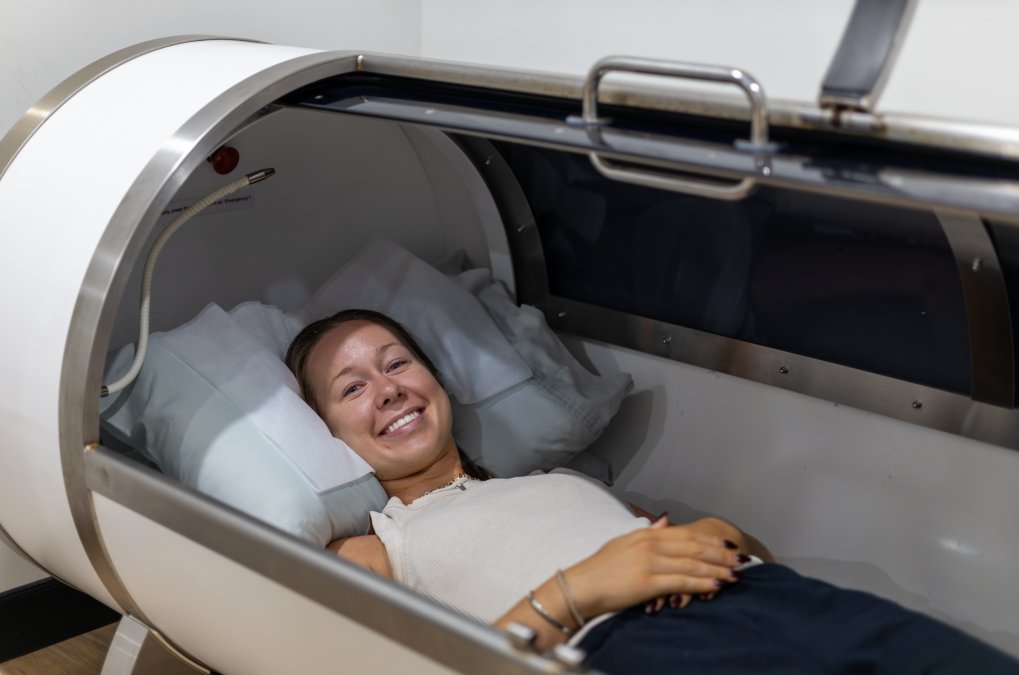
Hyperbaric oxygen therapy for sports injuries is one of the more misunderstood tools in a recovery toolkit. The treatment involves breathing near-100% oxygen inside a pressurised chamber, usually at 1.3 to 2.0 atmospheres absolute (ATA). At that pressure, far more oxygen dissolves directly into your blood plasma than it does at sea level, which means oxygen can reach tissue that normal circulation is struggling to supply.
The Mechanism, in Plain Terms
After a muscle tear, the injured area is often swollen and poorly perfused. White blood cells need oxygen to clear damaged tissue, and fibroblasts need oxygen to lay down new collagen. Hyperbaric oxygen is thought to support that process in three ways:
It increases oxygen delivery to the zone around the tear, where blood flow is temporarily reduced.
It can reduce swelling by narrowing blood vessels without starving the tissue of oxygen, since so much is carried in plasma.
It may support new capillary growth over repeated sessions, improving blood supply to the healing muscle.
What the Evidence Actually Supports
Most of the strongest evidence for hyperbaric oxygen comes from wound healing, crush injuries and post-surgical recovery, not from isolated calf strains. For soft tissue sports injuries, the research is promising but not definitive. A common pattern in the literature is that benefits are most likely when therapy starts early, typically within the first 48 to 72 hours, and when sessions are repeated daily for a defined block rather than used once or twice.
How It Fits a Calf Rehab Plan
Hyperbaric oxygen is a supporting therapy, not a substitute for progressive loading. The loading is what rebuilds strength; the chamber is there to help the tissue environment support that work. In practice, it fits best in the acute and early subacute phase, alongside protected loading and isometrics.
Watch Out Hyperbaric oxygen is not a shortcut. If you use it while skipping your loading program, you will still lose strength and still re-injure. The chamber supports the work; it does not replace it.
Nutrition, Sleep and Mental Recovery: The Factors Most People Ignore
Physical rehab gets all the attention, but three quieter factors shape how fast you heal. Nutrition, sleep and your mental state all influence tissue repair and how well you tolerate a slow comeback.
Nutrition for Tissue Repair
Muscle repair needs protein, and most active people under-eat it during injury. Aim for protein at every meal. Vitamin C supports collagen formation, and adequate hydration helps everything move. A common mistake is cutting calories hard while injured. That slows repair.
Sleep and Recovery Optimisation
Growth hormone release peaks during deep sleep, and that is when much of your tissue repair happens. Poor sleep slows recovery and raises pain sensitivity. Keep a consistent bedtime and avoid late caffeine.
Psychological Recovery: Staying Mentally Strong
Injury is frustrating. Setbacks feel personal. Runners and team athletes often report low mood during layoffs. Set small weekly goals, stay connected to your club, and celebrate range of motion gains, not just strength ones.
Key Takeaway The athletes who recover fastest are rarely the ones doing the most rehab. They are the ones sleeping well, eating enough protein, and staying patient with the timeline.
Conclusion: Building Your Torn Calf Recovery Plan
Torn calf recovery rewards patience more than effort. Grade your injury, load it in phases, and support the process with sleep, protein and honest pain tracking. Add therapies like contrast water therapy where they help you stay consistent.
Frequently Asked Questions
What is the fastest way to heal a torn calf muscle?
There is no single shortcut, but the fastest path combines early protection with progressive loading. In the first 48 to 72 hours, follow the RICE protocol: rest, ice, compression and elevation. Then begin isometric calf contractions as pain allows, and progress to eccentric loading and calf raises over the following weeks. Contrast water therapy and hyperbaric oxygen therapy may support circulation and tissue repair when used alongside your rehab program. A physiotherapist can tailor the timeline to your tear grade and sport.
How do you know if a calf tear is healing properly?
Signs of good healing include steadily decreasing pain, improved range of motion, and the ability to bear weight and walk without a limp. You should notice that daily activities become easier and that you can gradually add load without a sharp return of symptoms. If pain worsens, swelling increases, or you feel a popping sensation again, stop and seek a clinical assessment. A physiotherapist can use functional tests such as single-leg calf raises to confirm you are ready to progress.
Can contrast water therapy help with muscle tear recovery?
Contrast water therapy for muscle recovery alternates hot and cold water immersion, which may help reduce swelling and improve circulation. Some athletes report less soreness and better perceived recovery. It is not a replacement for progressive loading and rehabilitation exercises, but it can be a useful addition once the acute phase has passed. Always check with your healthcare provider before starting, especially if you have circulatory or cardiovascular conditions.
When should I start rehabilitation exercises for a calf strain?
Start gentle isometric exercises as soon as pain allows, often within the first week, provided you can do them without sharp pain. Begin with low-intensity contractions, then add range and load gradually. A typical program moves from isometrics to eccentric heel drops, then to progressive calf raises and eventually plyometrics. The calf strain recovery timeline varies by grade, so a physiotherapist should guide the pace to avoid re-injury.
A torn calf can feel like it will never heal, especially when you are watching from the sideline. At RIGS Brookvale, we help you rebuild with contrast water therapy, hyperbaric oxygen chambers and infrared saunas, backed by a team that treats recovery as seriously as you do. Book your first session and get your comeback moving.
BOOK NOW


Comments